
How To
Japanese maple tree height by variety: dwarf to giant size ranges explained
Japanese maple trees (Acer palmatum) are famous for their stunning foliage and compact growth habits, but their mature height can vary dramatically depending on the variety.
Some stay as small as 3 feet, perfect for container gardens, while others reach 30+ feet, becoming majestic landscape focal points. The key to planning your garden is understanding these differences—and how to create the ideal conditions for your chosen tree.
If you love the idea of a dwarf Japanese maple but worry it might outgrow its space, don’t! Varieties like Acer palmatum 'Shishigashira' or 'Emperor I' stay under 10 feet even at maturity. Meanwhile, larger cultivars like Acer palmatum 'Bloodgood' can soar to 25 feet or more.
Let’s break down the most popular varieties and their mature heights to help you pick the perfect fit for your yard.
🌿 Pro Tip: Always check the spacing requirements for mature trees. A 15-foot tree needs at least 10 feet of clearance from structures, while dwarf varieties may only need 3–5 feet.
For container gardening, prioritize dwarf varieties like Acer palmatum 'Dissectum' or 'Emperor I.' These thrive in 15–25 gallon pots and can be moved seasonally to optimize sunlight. Just ensure your container has drainage holes to prevent root rot, a common issue with Japanese maples.
If you’re planting in the ground, soil quality becomes critical. Japanese maples prefer acidic, well-draining soil with a pH of 5.0–6.5. Amend heavy clay with compost or sand to improve aeration, and mulch annually with wood chips to retain moisture and regulate temperature.
One of the most misunderstood aspects of Japanese maple growth is their slow growth rate. Even fast-growing varieties like Acer palmatum 'Bloodgood' only gain 1–2 feet per year. Patience is key—your tree’s final height will depend on genetics, care, and time.
For urban landscapes with limited space, consider columnar varieties like Acer palmatum 'Tamukeyama.' These grow vertically, reaching 15–20 feet but with a narrow spread (only 3–5 feet wide), making them ideal for tight spaces between buildings or patios.
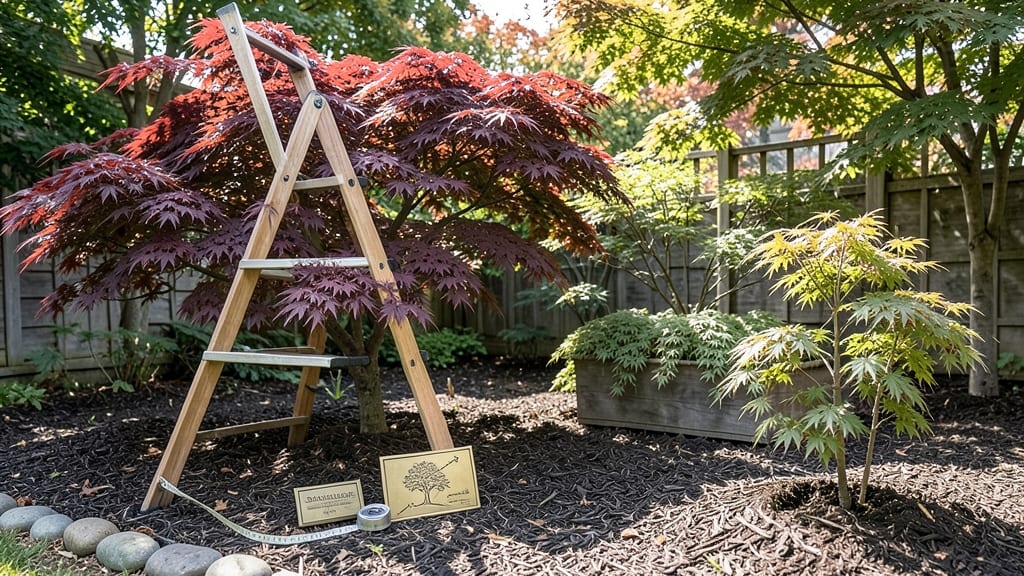
🌳 Visual Tip: Use a measuring tape when planting to mark the tree’s mature spread. This ensures you leave enough room for branches to extend without crowding other plants or structures.
Finally, remember that pruning can influence height. While you can’t drastically reduce a tree’s mature size, regular pruning (especially in early spring) helps maintain shape and encourages denser foliage. Avoid heavy pruning in late summer or fall, as this can stress the tree and stunt growth.
Factors that determine Japanese maple tree height: sunlight, soil, and pruning secrets
Japanese maple trees don’t grow to their full potential by accident—their height is shaped by your care choices and environmental conditions. While genetics set the baseline height for each variety, sunlight exposure, soil quality, and pruning habits can increase or decrease growth by up to 50%.
For example, a 'Bloodgood' maple might reach 20–25 feet in ideal conditions but stay under 15 feet if deprived of proper care.
Sunlight is the biggest growth regulator for Japanese maples. These trees thrive in dappled shade (morning sun + afternoon shade), which encourages slow, sturdy growth. Full sun can scorch leaves and spur rapid, weak growth, while deep shade stunts height and reduces vibrant foliage.
In my USDA Zone 7 garden, a 'Emperor I' maple grows 30% taller when planted under a light canopy of birch trees than when exposed to harsh afternoon rays.
Soil pH and drainage play a critical role too. Japanese maples prefer slightly acidic soil (pH 5.0–6.5) with excellent drainage. Compacted or alkaline soil restricts root growth, limiting height.
I once saw a 'Shishigashira' maple in a clay-heavy yard max out at 8 feet—half its expected height—because its roots couldn’t expand properly. Amending soil with organic matter (like compost or pine bark) can boost growth by 20–30% over time.
🌱 Growth Boosters vs. Growth Stoppers
✅ DO This
- Dappled shade: 4–6 hrs sun/day
- Acidic soil: pH 5.0–6.5
- Mulch yearly: 2–3" organic mulch
- Light pruning: Remove dead branches only
- Balanced fertilizer: 10-10-10 in spring
❌ Avoid This
- Full sun: Causes leaf scorch
- Alkaline soil: pH >7.0 stunts growth
- Over-pruning: >30% of canopy at once
- Heavy clay: Poor drainage = weak roots
- Winter salt: Damages roots near sidewalks
Pruning is where most gardeners accidentally sabotage their maple’s height. Heavy pruning in early spring can trigger vigorous but weak growth, while neglecting deadwood leads to a top-heavy, unstable tree.
The key is strategic thinning: Remove no more than 25% of the canopy per year, focusing on crossing branches or water sprouts. I prune my 'Orangeola' maple in late winter to shape its growth while it’s still dormant, and it maintains a compact, bushy form without sacrificing height.
Climate also significantly impacts growth rates. Japanese maples in warmer zones (8–9) grow 2–3 feet per year in ideal conditions, while those in cooler zones (5–6) may only gain 1 foot annually.
For example, a 'Crimson Queen' in Zone 8 might reach 15 feet in 10 years, but the same tree in Zone 6 could take 15 years to reach that height. Always check your USDA zone and adjust expectations accordingly.
If you’re planting for height control, consider these three pro tips: First, choose a dwarf variety (like 'Little Princess') if you want a 6–10 foot tree. Second, plant in partial shade to slow vertical growth while encouraging bushiness.
Finally, avoid fertilizing in fall—this prevents late-season flushes that can make trees top-heavy and prone to storm damage. With the right balance, you can shape your Japanese maple into the perfect size for your space—whether that’s a backyard centerpiece or a container-friendly patio tree.